
Average interest rate on housing loans has levelled off
In January, a Euribor rate was used as the reference rate in 94% of new housing loans. Over the past year, the popularity of the 12-month Euribor as a reference rate for new housing loans has declined, while shorter Euribors have gained ground. As regards the housing loan stock, 95% of loans used Euribor rates as the reference rate, while only 5% were fixed-rate or linked to banks’ own reference rates.
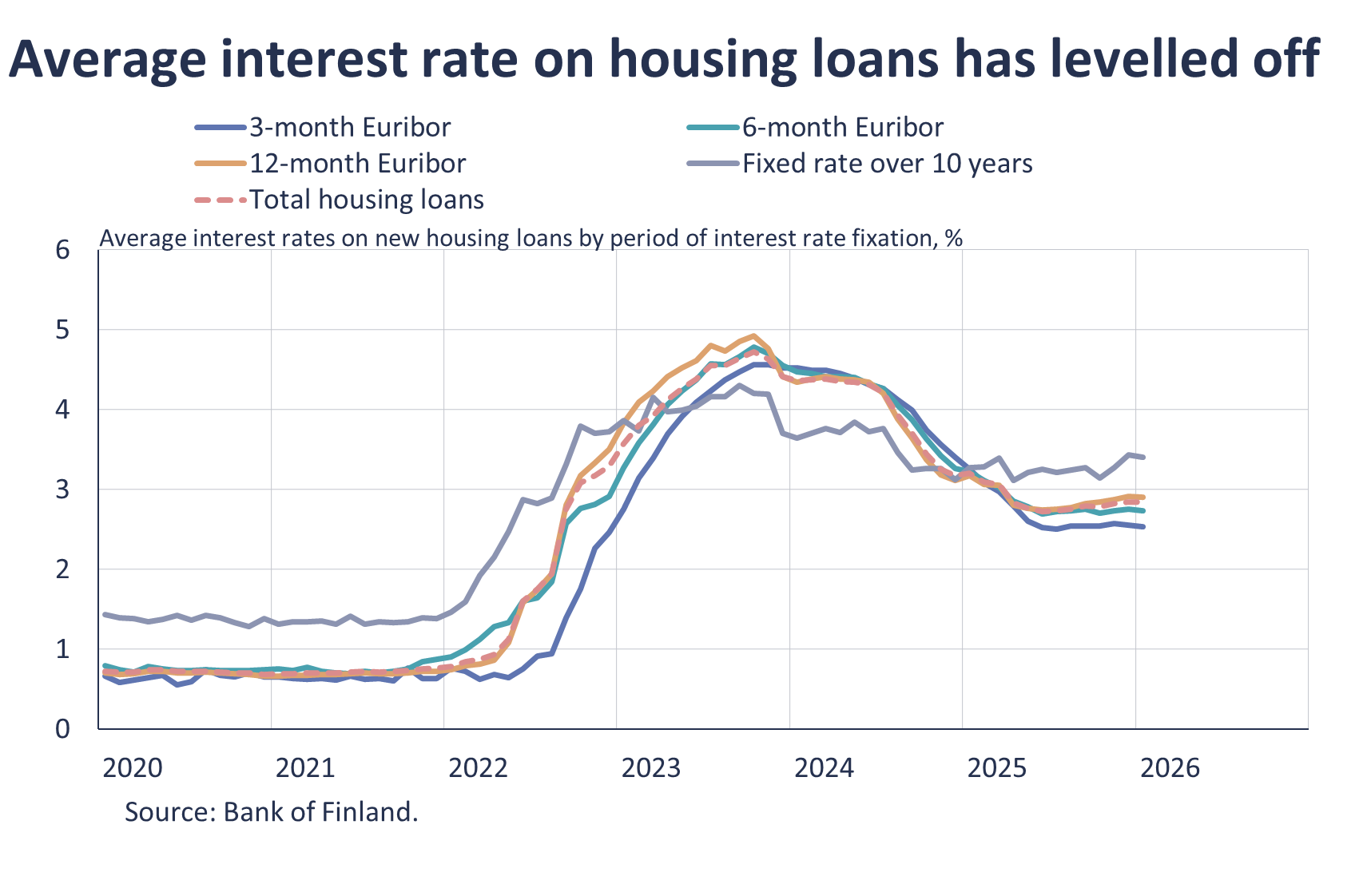
The average interest rate on new housing loans drawn down in January 2026 was 2.84%, compared with 3.20% in the corresponding period a year earlier. Since April 2025, developments in the average interest rate have been fairly stable, fluctuating between 2.73% and 2.85%. In Finland, developments in Euribor rates affect the interest rates paid on housing loans. In January, a Euribor rate was used as the reference rate in 94% of new housing loans.
Over the past year, the popularity of the 12-month Euribor as a reference rate for new housing loans has declined, while shorter Euribors have gained ground. In January 2026, 59% of new housing loans were linked to the 12-month Euribor, as opposed to 73% in the corresponding period a year earlier. In January 2026, 19% of new housing loans were linked to the 3-month Euribor and 16% to the 6-month Euribor, as opposed to 14% and 9%, respectively, a year earlier.
In January 2026, the average interest rates on new housing loans linked to shorter Euribors were lower than those linked to the 12-month Euribor, whereas a year earlier the rates on shorter Euribor-linked loans were slightly higher than on 12-month Euribor-linked new housing loans. In January 2026, the average interest rate on new housing loans linked to the 3-month Euribor was 2.53%, on those linked to the 6-month Euribor 2.73%, and on those linked to the 12-month Euribor 2.90%.
As regards the housing loan stock, 95% of loans used Euribor rates as the reference rate, while only 5% were fixed-rate or linked to banks’ own reference rates. The most common reference rate for housing loans is the 12-month Euribor. At the end of January 2026, 68% of the housing loan stock consisted of loans linked to the 12-month Euribor, 12% to the 6-month Euribor and 14% to the 3-month Euribor[1].
In January 2026, the average interest rate on the housing loan stock was 2.77%, compared with 3.49% in the corresponding period a year earlier. However, over the past few months, the decline in the average interest rate on the housing loan stock has almost come to a halt. In January 2026, the average margin on the housing loan stock (excl. interest-rate-hedged housing loans) was 0.65%, and on new housing loans 0.52%[2].
Loans
In January 2026, Finnish households drew down new housing loans worth EUR 883 million, which was 12% less than in the same period a year earlier and 23% less than the January average in 2003–2025. Of the newly drawn housing loans, buy-to-let mortgages accounted for EUR 96 million. The average interest rate on new housing loans declined slightly from December, to stand at 2.84% in January 2026. At the end of January, the stock of housing loans stood at EUR 105.7 billion, with a year-on-year change of +0.1%. Buy-to-let mortgages accounted for EUR 9.1 billion of the housing loan stock. At the end of January, Finnish households’ loans included EUR 17.4 billion of consumer credit and EUR 17.9 billion of other loans.
Drawdowns of new loans by Finnish non-financial corporations in January amounted to EUR 1.7 billion, with loans to housing corporations accounting for EUR 418 million. The average interest rate on new corporate-loan drawdowns increased slightly from December, to 3.77%. At the end of January, the stock of loans granted to Finnish non-financial corporations stood at EUR 108.7 billion, including EUR 46.0 billion of loans to housing corporations.
Deposits
At the end of January 2026, the total stock of Finnish households’ deposits amounted to EUR 116.4 billion, with an average interest rate of 0.79%. Overnight deposits accounted for EUR 70.7 billion and deposits with an agreed maturity for EUR 16.2 billion of the total deposit stock. In January, Finnish households entered into new deposit agreements with an agreed maturity in the amount of EUR 1.5 billion, at an average interest rate of 2.16%.
Loans and deposits to Finland, preliminary data |
|||||
| November, EUR million | December, EUR million | January, EUR million | January, 12-month change1, % | Average interest rate, % | |
| Loans to households, stock | 141,173 | 140,912 | 140,924 | 0.2 | 3.31 |
| - of which housing loans | 105,867 | 105,788 | 105,677 | 0.1 | 2.77 |
| - of which buy-to-let mortgages | 9,063 | 9,096 | 9,108 | 2.87 | |
| Loans to non-financial corporations2, stock | 108,914 | 108,775 | 108,654 | 2.5 | 3.29 |
| Deposits by households, stock | 115,725 | 115,239 | 116,371 | 4.7 | 0.79 |
| Households' new drawdowns of housing loans | 1,195 | 1,206 | 883 | 2.84 | |
| - of which buy-to-let mortgages | 113 | 119 | 96 | 2.95 | |
* Includes loans and deposits in all currencies to residents in Finland. The statistical releases of the Bank of Finland up to January 2021, as well as those of the ECB, present loans and deposits in euro to euro area residents and also include non-profit institutions serving households. For these reasons, the figures in this table differ from those in the aforementioned releases.
1 Rate of change has been calculated from monthly differences in levels adjusted for classification and other revaluation changes.
2 Non-financial corporations also include housing corporations.
- Euro-denominated deposits and loans of euro area residents: stock, 12 month rate of change and average interest rate
- Euro-denominated loans and deposits of Finnish households
- New business on loans and new drawdowns of household loans
- Finnish contribution to the euro area monetary aggregates and their main counterparts
- Imputed interest rate margins on loans from MFIs
The next news release on money and banking statistics will be published at 10:00 on 27 March 2026.
Related statistical data and graphs are also available on the Bank of Finland website: https://www.suomenpankki.fi/en/statistics.
The statistical data are also available via an API from the Bank of Finland’s open data portal. For details, see https://www.suomenpankki.fi/en/statistics/open-data
[1] Source: Positive credit register. The use of new data and the interpretation of figures may involve uncertainty. The uncertainties are reduced as more data is collected and more experience is gained about its detailed analysis.
[2] Source: Positive credit register. Average margin weighted by loan volume.