
Housing loans with longer maturities have increased in number
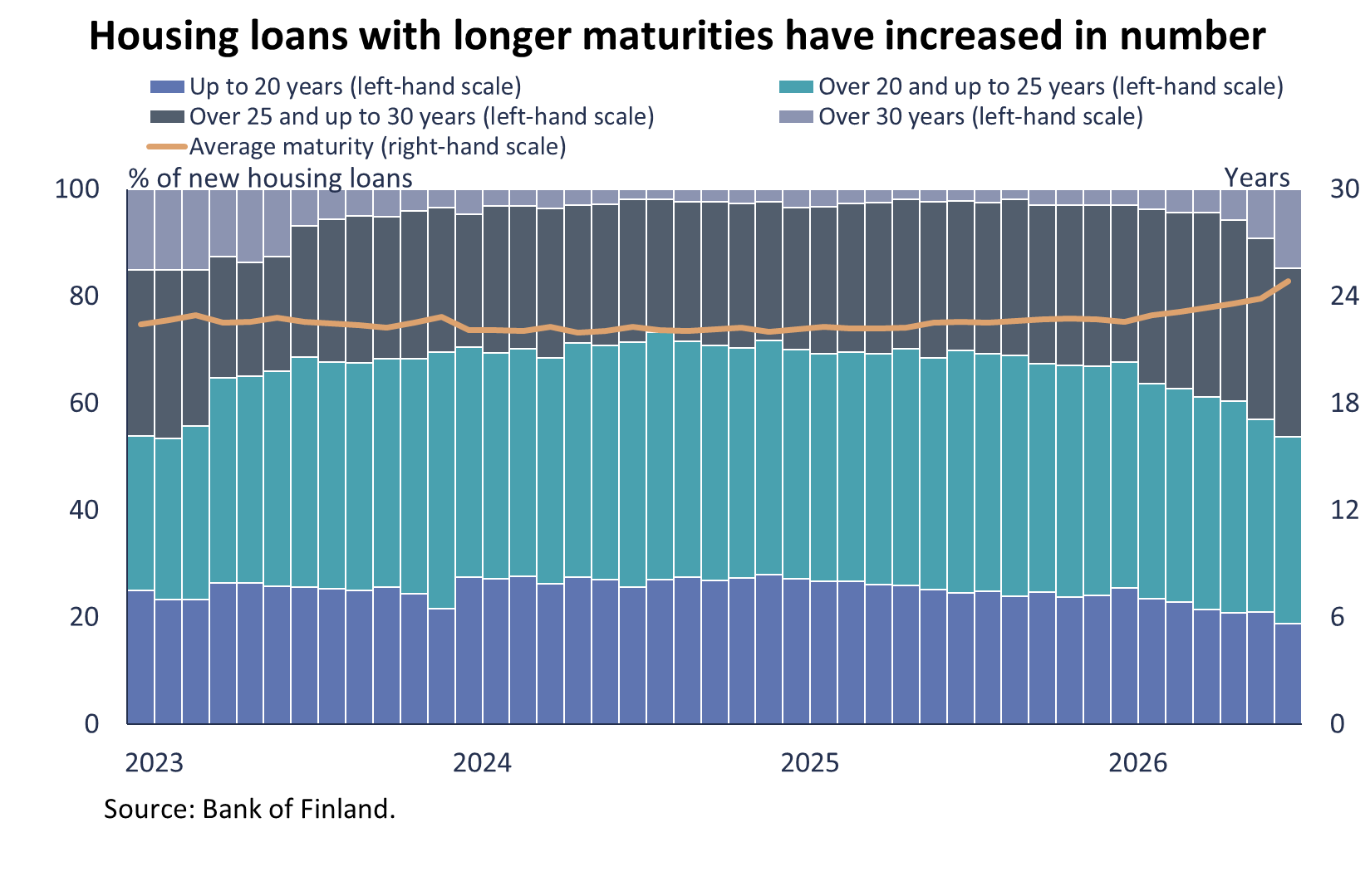
In July 2026, the average maturity of new housing loans, including buy-to-let mortgages, was longer than ever before in the statistical history, at nearly 25 years1. Drawdowns of new housing loans in July were 6% lower than in the corresponding period a year earlier.
At the beginning of June 2026, the maximum maturity of housing loans was extended from 30 years[1] to 40 years[2]. This change is evident in the housing loan figures for June and July 2026, which show an increase in the number of housing loans with longer maturities. In July, the average maturity of housing loans was 1 year and 3 months longer than in May 2026. Since the beginning of 2026, the average maturity has lengthened by more than two years.
In July 2026, the average maturity of new owner-occupied housing loans exceeded 25 years, standing at 25 years and 3 months, compared with 23 years and 10 months two months earlier, in May. In July, more than 16% of owner-occupied housing loans had a maturity of over 30 years, compared with 6% in May. The most common maturity for owner-occupied housing loans in July was 24–25 years, accounting for 30% of the loans, followed by 29–30 years, accounting for 18%.
Buy-to-let mortgages have shorter maturities on average than owner-occupied housing loans. Their average maturity has nevertheless lengthened by 1 year and 4 months since the beginning of 2026 and exceeded 21 years in July.
Drawdowns of new housing loans in July 2026 amounted to EUR 1.2 billion, which was 6% less than in the corresponding period a year earlier and 15% less than the average for July.[3] Drawdowns of new buy-to-let mortgages were 1% higher than a year earlier, while drawdowns of owner-occupied housing loans were 6% lower. The average interest rate on housing loan drawdowns was 3.28% in July 2026, compared with 2.74% in July 2025.
Loans
At the end of July 2026, the stock of housing loans stood at EUR 105.4 billion, representing a year-on-year change of –0.2%. Buy-to-let mortgages accounted for EUR 9.2 billion of the housing loan stock. At the end of July, Finnish households’ loan stock included EUR 17.4 billion in consumer credit and EUR 17.8 billion in other loans.
Finnish non-financial corporations drew down EUR 5.1 billion in new loans[4] in July, of which loans to housing corporations accounted for EUR 790 million. The average interest rate on new corporate loan drawdowns decreased from June, to 3.45%. At the end of July, the stock of loans granted to Finnish non-financial corporations stood at EUR 113.2 billion, of which loans to housing corporations accounted for EUR 46.8 billion.
Deposits
At the end of July 2026, the aggregate stock of deposits held by Finnish households stood at EUR 118.0 billion, and the average interest rate on the deposits was 0.87%. Overnight deposits accounted for EUR 71.9 billion of the deposit stock and deposits with an agreed maturity for EUR 17.2 billion. In July, Finnish households entered into new agreements on deposits with an agreed maturity totalling EUR 1.5 billion. The average interest rate on these new deposits was 2.57%.
Loans and deposits to Finland, preliminary data |
|||||
| May, EUR million | June, EUR million | July, EUR million | July, 12-month change1, % | Average interest rate, % | |
| Loans to households, stock | 140,625 | 140,654 | 140,658 | 0.2 | 3.51 |
| - of which housing loans | 105,474 | 105,396 | 105,410 | -0.2 | 2.98 |
| - of which buy-to-let mortgages | 9,188 | 9,193 | 9,213 | 3.08 | |
| Loans to non-financial corporations2, stock | 109,902 | 110,779 | 113,245 | 5.6 | 3.54 |
| Deposits by households, stock | 118,003 | 118,120 | 118,0 | 2.9 | 0.87 |
| Households' new drawdowns of housing loans | 1,177 | 1,290 | 1,197 | 3.28 | |
| - of which buy-to-let mortgages | 108 | 112 | 120 | 3.34 | |
* Includes loans and deposits in all currencies to residents in Finland. The statistical releases of the Bank of Finland up to January 2021, as well as those of the ECB, present loans and deposits in euro to euro area residents and also include non-profit institutions serving households. For these reasons, the figures in this table differ from those in the aforementioned releases.
1 Rate of change has been calculated from monthly differences in levels adjusted for classification and other revaluation changes.
2 Non-financial corporations also include housing corporations.
- Euro-denominated deposits and loans of euro area residents: stock, 12 month rate of change and average interest rate
- Euro-denominated loans and deposits of Finnish households
- New business on loans and new drawdowns of household loans
- Finnish contribution to the euro area monetary aggregates and their main counterparts
- Imputed interest rate margins on loans from MFIs
The next news release on money and banking statistics will be published at 10:00 on 28 September 2026.
Related statistical data and graphs are also available on the Bank of Finland website: https://www.suomenpankki.fi/en/statistics/.
The statistical data are also available via an API from the Bank of Finland’s open data portal. For details, see https://www.suomenpankki.fi/en/statistics/open-data/.
[1] The maximum maturity of new housing loan agreements had been limited to 30 years from July 2023. However, a lender was permitted to deviate from the maximum maturity in respect of 10% of its total housing lending in each quarter.
[2] The maximum maturity of new housing loan agreements has been limited to 40 years since June 2026. A lender may not include terms in a housing loan agreement under which, at the time the loan is granted, the maturity would exceed 40 years from the date on which the loan is drawn down. However, a lender is permitted to deviate from the maximum maturity in respect of 10% of its total housing lending in each quarter.
[3] The average for July in 2011–2025.
[4] Excl. overdrafts and credit card credit.