
Back to school: Passing Europe's triple test
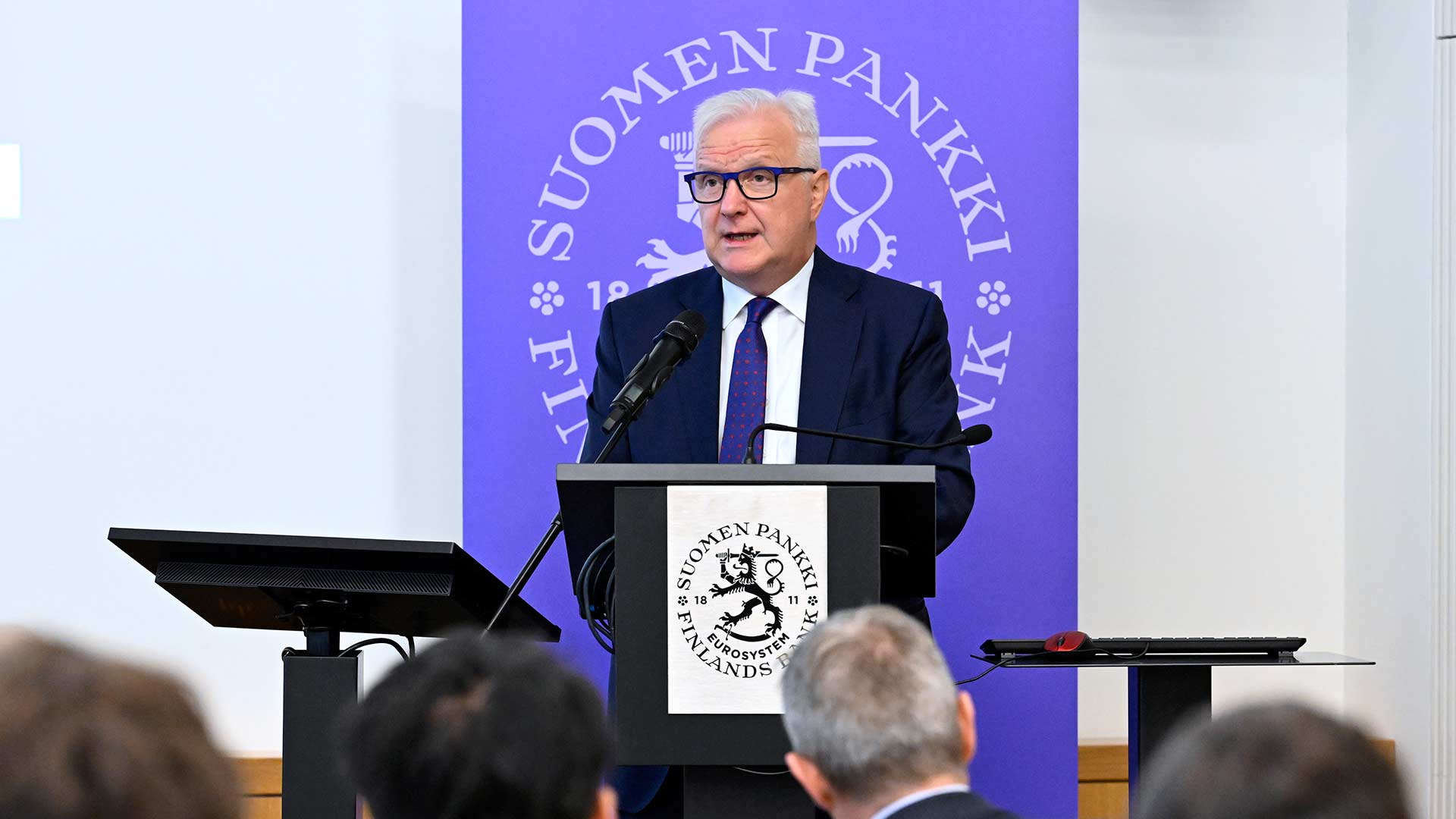
Europe faces a triple test: it must strengthen its defense capabilities, diversify its energy sources while accelerating the green transition, and improve productivity through investment and innovation. Governor Olli Rehn gave a keynote speech at OMFIF Nordic SSA Forum in Helsinki on 19 August 2026.
Presentation slides (PDF)
Ladies and Gentlemen, Dear Colleagues and Friends,
It is a great pleasure to address OMFIF's Nordic SSA Forum, here at the premises of the Nordic Investment Bank. Now that the summer holidays are over, this event provides us with a perfect opportunity to take stock of the tasks ahead. The children are back at school, so it is time for us as well to roll up our sleeves and get back to work.
For me personally, this is both a particularly interesting and a rather convenient event: the NIB is just a stone's throw from my office at the Bank of Finland or, as we might say, only one goal-kick away.
And as in football, so too in financial markets: the quality of the pitch matters. Deep, liquid and integrated capital markets would give Europe a stronger foundation to build on. We have good players and strong institutions, but the infrastructure around them still needs work if Team Europe is to perform at its best.
My remarks today will focus on Europe's current challenges — what I call the triple test — and on one important building block for addressing it: a common European safe and liquid asset. With sufficient ambition and proper design, such an asset could help Europe advance several objectives at once — from strengthening financial stability and supporting investment to reinforcing the international role of the euro.
Before turning to Europe's structural challenges, however, let us look first at the shock that is testing our resilience today: the oil and gas supply shock stemming from the Iran war and the wider Middle East conflict.
SLIDE 2: Inflation and interest rate expectations
By the start of this year, euro area inflation had stabilised at around 2%. Market expectations for the ECB reflected that: the prevailing view was that the policy rate would remain around 2% for some time. As President Lagarde often said, we were in a good place.
Then, at the end of February, the Iran war severely disrupted the oil market, leading to the unprecedented closure of the Strait of Hormuz.
The shock disrupted global energy flows, trapping around one-fifth of global oil and LNG exports — and most spare production capacity — in the Persian Gulf.
Energy shocks reach every part of society. Higher energy prices push up inflation both directly and indirectly. And they raise the risk of second-round effects through wages and broader price-setting.
The chart illustrates the scale of the shock. In June, we raised interest rates while markets began to price in a more restrictive policy stance than before the conflict. In July, we kept rates unchanged, while assessing how persistent the shock would prove and what indirect and second-round effects it might have on inflation.
So far, wage growth and the wage outlook have remained moderate, with no clear signs of second-round effects. Keeping inflation expectations anchored will be essential to ensure this remains the case.
Designing the appropriate policy response to this supply shock is at the core of our work on the ECB Governing Council. We next meet in September to reassess the situation and outlook.
SLIDE 3: Geopolitical uncertainty has increased
The conflict in the Middle East is a reminder of how events outside Europe can have direct and far-reaching consequences for us. We have seen this before, and we should not assume it will be the last time.
Recent events point to a broader pattern. In 2022, Russia invaded Ukraine. Since 2025, we have seen a paradigm shift in US trade and foreign policy. Geopolitical uncertainty has risen sharply.
Technology presents another challenge. The concentration of power among tech giants outside Europe means that critical infrastructure increasingly lies beyond European control. This is true of AI and beyond.
The current energy shock, together with this summer's deadly heatwave, underlines the need to reduce our dependence on fossil fuels and to tackle climate change, which is increasing the risk of extreme weather.
We cannot prevent every adverse event. But we can make Europe more resilient. That is the test of our time.
SLIDE 4: Europe's strategic triple test
Europe's future will depend on whether we can deliver on three fronts: defence, energy and productivity.
First, Europe must take greater responsibility for its own defence. This requires more joint investment and procurement, so that higher spending translates efficiently into real capabilities to defend Europe together.
Second, Europe needs a broader range of non-fossil energy sources, suppliers and technologies — and greater investment in renewables and nuclear power. The green transition is not only about climate. It is fundamentally about Europe's energy security and economic resilience.
Third, Europe must boost its productivity growth and economic competitiveness. This requires investment in human capital, deeper capital markets, less red tape and more innovation.
Political leaders cannot simply legislate higher productivity into existence, and even where it does improve, it does so gradually. It will not solve the immediate challenge of financing Europe's investment needs.
But policy can do much to improve how those investments are financed — and that brings us directly to today's discussion.
When it comes to financing investment, and subsequently issuing debt, the European Union is still a team of 27 solo players — alongside several EU and euro area institutions issuing their own bonds. In financial markets, this fragmentation matters, and not to our advantage. Europe's funding needs are large or even huge, and our capital markets should better match the scale and needs of the European economy.
Delivering the Savings and Investments Union is therefore critical.
And this leads to the question I want to put on the table today: what role could a common European safe asset play in this architecture?
SLIDE 5: A European safe and liquid asset
Don’t get me wrong: I have been in this business long enough not to underestimate the formidable political and institutional obstacles.
From a political perspective, a common European safe asset remains difficult – for some, a non-starter. But from the political economy perspective, and from the European standpoint, I won’t say it is a no-brainer but certainly I would argue that the case for it is compelling.
Why? – Because a well-designed European safe asset could contribute to several of the objectives I have just described.
First, it could provide a foundation for deeper and more integrated European capital markets.
Second, a deeper market in European safe assets could support the international role of the euro.
Third, by providing investors with a highly liquid and convenient asset, it could generate a convenience yield and help reduce financing costs in Europe.
There are potential financial stability benefits as well. In periods of market turbulence, genuinely safe and liquid assets can serve as havens and remain liquid when other parts of the market come under stress.
A sufficient supply of European safe assets could also support more effective monetary policy transmission. Changes in policy rates could pass more smoothly to market rates and ultimately to the real economy.
A common safe asset could also provide a neutral pricing benchmark and a core source of collateral in repo and derivatives markets.
The ECB's June 2026 report on the international role of the euro confirms that the euro remains the world's second most important currency. For our part, we remain committed to price stability. And we have the tools to ensure that monetary policy is transmitted smoothly across the euro area, even when unwarranted or disorderly market dynamics emerge.
We have also recently enhanced EUREP, our repo facility that allows foreign central banks to access euro liquidity against high-quality euro-denominated collateral when pressures arise.
These are steps in the right direction, but they should not make us complacent. The constraints we face are structural, and structural gaps do not close by themselves. A global currency needs deep and liquid financial markets. It needs a trusted benchmark asset. The United States has one in the Treasury market. This is one pillar of the dollar's global role — and of America's "exorbitant privilege."
Today, Europe helps finance that privilege. A substantial share of European savings flows to the United States and finances investment there. A European safe asset could help reduce that outflow, keeping more European savings in Europe to finance our own priorities.
So, what is Europe missing?
Europe and the United States are both large, diverse economies with substantial stocks of public debt. But the United States has one clear advantage: it issues vast quantities of debt under a single sovereign name. US Treasuries amount to around $30 trillion. Europe's combined public debt is roughly one-third of that. On paper, this should be enough to support a safe asset with considerable depth and liquidity.
The problem is fragmentation.
Today, German government bonds are generally regarded as the euro area's main safe asset, but their supply is limited.
There are also market-structure issues. EU debt is still treated as supranational, not as sovereign debt. This has practical consequences: for example, EU bonds are not included in some major sovereign bond indices, which limits their investor base and affects how they trade.
There is also too little clarity about the long-term role of EU debt and the future scale of issuance. According to OMFIF's 2026 survey of global public investors, 55 per cent of respondents said they would increase their euro holdings if the EU became a permanent, large-scale issuer.
That is a useful signal. But it is not, by itself, an answer.
We need to examine carefully what would make a European safe asset genuinely safe, liquid and credible.
How much issuance would be needed? What should back it? What should it finance? How should it interact with national sovereign debt markets? And what institutional arrangements would make it durable across political and economic cycles?
We may not yet have a definitive solution, but we can make progress while preserving the incentives for sound national public finances.
Common European instruments can be part of the answer to the triple test. This matters, especially since many EU Member States have limited fiscal space while Europe's investment needs are large.
Given the EU's unique institutional structure, any significant scaling-up would require stable and sufficient EU own resources and clear rules on how funds are used. It would require democratic accountability and economic sustainability. Sound national public finances remain essential as we develop joint financing instruments.
Dear friends,
Let me conclude.
Europe's growing investment needs, especially in European public goods, are changing the terms of the debate on common financing.
We cannot stand still, unless we are satisfied with our current irrelevance.
So, before asking what is politically possible today, I would encourage us all to think about what is economically meaningful, financially viable and policy-wise workable. How can we build a European safe asset that meets the highest standards of safety, liquidity and credibility?
Let me close by wishing you all a fruitful forum and a most productive exchange of ideas!