
Systemic risk, resilience and competitiveness in a changing technological landscape
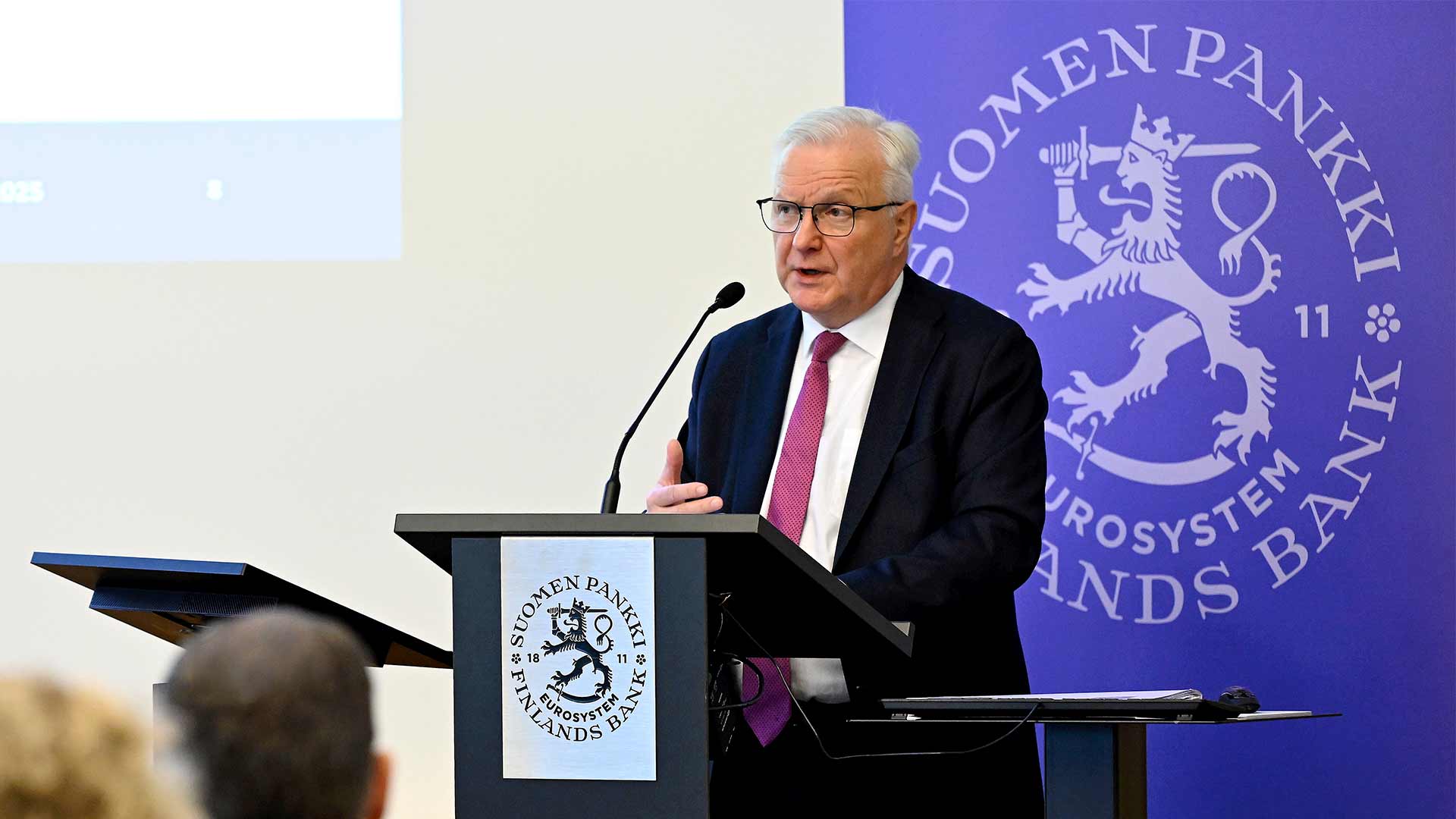
Governor Olli Rehn held a keynote speech about systemic risk, resilience and competitiveness in a changing technological landscape at the 11th Bank of Finland and European Systemic Risk Board Joint Conference on AI and Systemic Risk Analytics in Helsinki on 3 June 2026.
Dear Ladies and Gentlemen, Colleagues and Friends,
Let me wish you a very warm welcome to the 11th Bank of Finland and European Systemic Risk Board Joint Conference on AI and Systemic Risk Analytics. It is a great honour and pleasure to see so many of you here today, both in person and online.
As we all know, the world is changing at an accelerating pace. In recent years, crises have followed one after the other, with little breathing space and oftentimes even in parallel – and there is no clear end in sight. At the same time, powerful long-term forces, megatrends − especially geopolitical confrontation and rapid technological change − are reshaping our economies and societies, as well as international relations.
As policymakers, we must keep pace with these transformative shifts while safeguarding financial stability and supporting sustainable growth.
This of course is where risk management comes in. Let me pick one worthy reminder of that by a seasoned practitioner. In his recent, and I should say, street-smart memoir Streetwise, former Goldman Sachs CEO Lloyd Blankfein refers to a lengthy op-ed he wrote in the Financial Times in 2009, in which he observed: “too many financial institutions and investors simply outsourced their risk management”.
At the time, it was a rare but significant observation from a leading banker. And it remains a crucial lesson still today, which us policymakers and supervisors are well aware and carry with us as a constant concern, and keep reminding the financial industry. Analysing, understanding and managing risks is something that cannot be outsourced.
In times of bull markets, it is easy to see the temptation for neglecting risk. As the maverick-turned-legendary economist Hyman Minsky famously argued, stability itself can become destabilising. Long periods of calm do feed complacency, risk-taking and excessive confidence. We know this pattern all too well from financial history.
Today, in the age of artificial intelligence and rapid technological disruption, that lesson is once again highly relevant.
In the rest of my remarks today, I will first discuss how financial authorities monitor systemic risks and how this work must now evolve. I will then turn to technological change − especially AI − highlighting both its opportunities and its risks. Finally, I will reflect on what Europe needs to do in order to reinforce both its resilience and competitiveness in a global landscape characterized by geoeconomic fragmentation.
As financial stability authorities, we are accustomed to monitoring systemic risks. Analysing traditional vulnerabilities remains a core part of our work. We study how risks emerge and evolve, and we track financial cycles and structural developments within the financial system.
But today, this is no longer sufficient.
Systemic shocks increasingly originate outside the traditional financial sector. Geopolitical tensions and conflict, technological disruption, hybrid threats and climate-related risks can all have major consequences for financial stability.
We must ask what these factors mean for systemic risk. We need to understand how new actors, technologies and business models are connected to the financial system − and how risks may spread through these interconnections.
In 2024, the High-Level Group on the ESRB Review, which I had the privilege to chair, recommended a more holistic assessment of systemic risk, with greater attention to interdependencies, spillovers and cross-border vulnerabilities. The ESRB has already aligned its work accordingly, but much remains to be done to keep pace with fast-moving developments.
This is why policy-relevant, high-quality research is more important than ever. We need to combine expertise, data and analytical methods in new ways. And this requires close cooperation not only among central banks and supervisory authorities, but also with academia and the broader research community.
Let me now turn to technological change and artificial intelligence.
Operational resilience is becoming a central pillar of financial stability. In a world increasingly shaped or influenced by AI systems and automated decision-making, it is evident that the underlying code and cyber resilience of financial systems have become critically important.
AI, quantum computing and related technologies are creating major opportunities − but also major risks.
The financial sector is already facing a rapidly evolving cyber threat landscape. AI-powered cyberattacks are becoming more sophisticated, scalable and difficult to detect. Vulnerabilities can now be exploited much faster than before – I’m sure you have all heard about ‘Mythos’, and there will no doubt be others to come. This creates systemic concerns for banking and payment systems, especially if operational disruptions spread across borders or highly interconnected institutions.
And the race between attackers and defenders is intensifying.
Resilience therefore requires constant investment − in technology, cybersecurity and, above all, highly skilled people. Without sufficient expertise and preparedness, operational vulnerabilities can quickly become systemic risks.
Many AI systems remain opaque and, for many, difficult to explain or understand. Dependence on a small number of dominant technology providers creates concentration risks. And large-scale cyber incidents could undermine public trust in the financial system.
As guardians of stability, we must remain vigilant. Innovation is essential − but so too is risk management. We cannot allow our capacity to innovate to exceed our capacity to manage risks.
I shall now turn to the impact of AI on the economy and labour market.
There is currently enormous optimism, especially in equity markets, surrounding AI and productivity growth. Some of this optimism may well be justified. But the benefits of AI are not automatic.
Much depends on whether societies are able to adapt − and especially on whether workers have the skills needed to work with the new technologies.
AI can complement human work and raise productivity. But it can also replace tasks and jobs, including routine expert and administrative work. In such cases, the range of consequences may include unemployment, income losses, inequality and higher credit risks.
As a case in point, according to the IMF, Finland is relatively well positioned to benefit from AI. Yet, by many estimates, around one fifth of the workforce is employed in occupations where AI may replace tasks rather than complement them.
This means that adjustment pressures could become significant.
What’s more, productivity gains observed in individual tasks do not automatically translate into economy-wide gains. Successful adoption of AI requires complementary investments in education, training, skills development, organisational reform and innovation capacity.
Without this adjustment capacity, productivity gains may remain weak, while social costs become substantial.
That is why education, training, continuous learning and skills upgrading are absolutely essential. It is all about human capital.
The key question is therefore not whether AI will change the economy − spoiler alert: it will − but whether societies are prepared for that change.
Technological progress does not automatically generate broadly shared prosperity. Everybody must be kept on board. History shows that the gains from technological revolutions depend critically on education systems, labour market adaptability and public trust.
* * *
What, then, does Europe need in order to succeed in this new environment? It needs to focus on four areas, in particular.
First, entrepreneurship and innovation. Regulation must be clear, predictable and innovation-friendly.
Europe’s simplification agenda is therefore important. We need rules that support innovation, while preserving financial stability and trust.
This goes for the banking sector as well. Europe needs competitive and resilient banks. Financial stability is not an abstract technocratic concern. It is the foundation of growth, investment and trust.
The reforms after the global financial crisis have made European banks far more resilient. Recent shocks have tested this framework severely. Yet the banking system has remained broadly stable.
That resilience was built up over many years. It was not created automatically or overnight.
But regulation introduced during times of crisis has also become increasingly complex. This is a competitiveness issue for Europe.
The answer, I must emphasise though, is not deregulation. We must not throw the baby out with the bathwater. Strong capital buffers remain essential for financial stability and economic resilience.
The goal – and my second point − should instead be smarter and simpler regulation: streamlining reporting requirements, clarifying supervisory guidance, reducing overlaps and improving consistency across Europe.
Stability and competitiveness are not contradictory goals. On the contrary, they reinforce one another. Stability builds trust. Trust supports investment and competitiveness, helping foster stability in the long run.
Third, Europe needs deeper capital market integration and stronger investment capacity, as emphasised in the Draghi report. Completing the Savings and Investments Union should now become a strategic priority.
Households across the EU countries currently hold 11 trillion euros in bank deposits. A larger share of these savings should be channelled into productive investment. This would support innovation, boost European companies and improve long-term household wealth.
Access to finance is particularly important for firms at the scaling phase. Otherwise, Europe risks losing promising companies and technologies to other jurisdictions.
Fourthly, and finally, Europe must invest in education, research and talent – that is, invest in its biggest asset: human capital.
In a dynamic economy, this would clearly not all be home-grown talent. A stable European environment and competitive universities can attract highly skilled people from around the world.
And above all, Europe needs peace, stability and reform. This leads back to the geopolitical environment. In a world increasingly shaped by strategic rivalry, Europe must strengthen its common defence and strategic autonomy − not by turning inward, but by building institutions that are resilient, innovative and credible.
Dear Friends,
Let me now conclude.
It is clear that artificial intelligence will create major opportunities but also bring major adjustment pressures. The benefits are not, and will not be, automatic. Much depends on whether we invest sufficiently in skills, resilience, innovation and trust.
Managing both traditional and emerging risks will remain essential for financial stability. In all of this, we must remind ourselves too that the future is not something that simply happens by itself. It must be built − together and with our focus firmly on the job at hand.
This conference provides an excellent opportunity to deepen our understanding and boost cooperation on these critical matters – across institutions and disciplines and through high-quality research and analysis.
As the Bank of Finland’s slogan puts it: Securing stability, in science we trust.
Thank you.